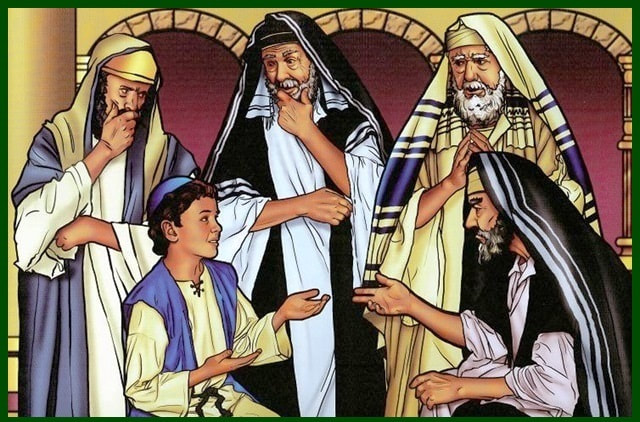
I confess yesterday I thought him quite bright.
At just twelve, the Tanakh[1] he can well recite.
He won’t stop asking questions that test our wit.
And his answers are deftly formed I’ll admit.
“Could Melchizadek[2], Salem’s King[3][4], wise and spry,
Be held righteous, the Priest of our God Most High[5],
When he lived before Moses received the law[6],
Blessing Abram in God’s name, inspiring awe?”
By himself he is here in the temple court,
With the gathering crowd and their sharp retort.
He goes on pointing out each contrary verse
While these priests offer answers both brief and terse.
“With no child born to Abram why did God say
That because to my voice you hear and obey
Through your seed all the nations on earth are blessed[7]?
Then he chose the twelve tribes[8], but what of the rest?”
He’s gone back to a time of ancients, long past,
To the tales that leave neophyte priests aghast.
Does this boy spend his time thinking up such things?
He is valiant though he might be facing slings.[9]
“How did Isaac with Abraham alter life;
Transform love after bound underneath the knife[10]?
How could love follow through and give up a son?[11]
Why did God then arrange fitting provision?”[12]
Oh, now Isaac was challenged in days of old!
Who would climb up the wood pile as he was told?
With no sacrifice found to assume his place,
Who could trust his own sire and depend on grace?
“What could God do with one who’s a murderer?
Might he lead Israel or serve as herder?
Could our Lord humble him[13], could he then survive
And become one through whom the elect will thrive?”
Is it Moses[14]or David[15]to whom he refers?
Such a trap in this query, for he infers
Despite trespass our Lord still can work his will
Through the sinners and humble who seek him still[16],[17].
“What of Zorah’s son Sampson the Nazarite
Who found temper and women his appetite[18]?
And was Hannah’s heart vow a just memento
Leaving Samuel with Eli within Shiloh[19],[20]?”
Now he talks about women! Why waste our time?
They’re just mothers who fit the old paradigm.
T’was their sons who were strong, and they changed our land
And allowed us to follow our way as planned.
“Then when God said to Eli ‘a priest he’d raise
Who would follow His heart and mind all his days’[21],
Was he saying that Samuel had been chosen
And that Eli’s own lineage would be cloven?”
Now the priesthood from Levi is through bloodline.
It was Samuel who changed things though we did fine.
He set Kings o’er our people, diminishing priests
Yet we press on with sacrifice and our feasts.
“Had both Hophni and Phinehas worked their will
When they carried the Ark into conflict, still
Seeking victory precious that would not come,
But resulted in death as the true outcome?[22]”
Those two fools[23]lost the ark in their war that day!
When outflanked by those Gentiles they passed away.
Now just what were they thinking to risk that gold?
Those at Ashdod got tumors, the tale is told[24].
“And when Eli was told of this awful thing
then his chair tipped, he fell, and he knew death’s sting[25].
Yet the idol of Dagon fell on it’s face[26].
Was the Spirit of God at work in that place?[27]”
Oh, the questions he asks open other doors[28]
Which erode the respect of my role and yours[29].
He won’t stick to the teachings that we all preach
As he prods and confuses those that we teach.
(C) 2017 Chuck Curtiss
To fast forward and pick up this story see A Man of The Law II: Going Astray
To read other similar stories in this series see The Witness List.
Based on Luke 2:41-52
All Scripture quotations, unless otherwise indicated, are taken from the Holy Bible, New International Version®, NIV®. Copyright ©1973, 1978, 1984, 2011 by Biblica, Inc.™ Used by permission of Zondervan. All rights reserved worldwide. http://www.zondervan.com.
The “NIV” and “New International Version” are trademarks registered in the United States Patent and Trademark Office by Biblica, Inc.™
The footnotes below show definitions and/or Scripture references. The Hebrew version of the English name is shown, romanized, at the right in italics)
[1]Also called the Mikra or Hebrew Bible. This is an acronym for three major sections comprising what Christians may call “The Old Testament”, including: the Torah (5 books of Moses), Nevi’im (Prophets) and Ketuvim (Writings)
[2]Psalm 110:4 (Tehillim),Hebrews 5:1-10, Hebrews 7:1-28
[3]Psalm 76:1-2 appears to say that the location of Salem is on Mt Zion, which is also a description of the location of Jerusalem
[4]http://bibleatlas.org/salem.htm
[5]Genesis 14:18-20 (B’resheet), Hebrews 6:13-20
[6]Exodus 24 (Sh’mot)
[7]Genesis: 22:15-18 (B’resheet)
[8]Deuteronomy 7:6-11 (D’varim)
[9]Zechariah 9:9-17 (Z’kharyah)
[10]Genesis 22:1-14 (B’resheet)
[11]John 3:14-18 (Yochanan)
[12]Genesis 22:8 (B’resheet), Exodus12:5 (Sh’mot), Isaiah 53:7 (Yesha’yahu), John 1:29 (Yochanan), 1 Peter 1:18-20(1 Kefa),Revelation 5:6-14
[13]2 Chronicles 7:14 (Divrei-Ha Yamim Bet)
[14]Exodus 2:11-15 (Sh’mot)
[15]2 Samuel 11-21 (Sh’mu’el Bet)
[16]Zechariah 3 (Z’kharyah)
[17]Isaiah 64:6 (Yesha’yahu)
[18]Judges 13-16 (Shof’tim)
[19]1 Samuel 1-2:11 (Sh’mu’el Alef)
[20]https://en.wikipedia.org/wiki/Shiloh_(biblical_city)
[21]1 Samuel 2:27-36 (Sh’mu’el Alef)
[22]1 Samuel 4:2-11 (Sh’mu’el Alef)
[23]Matthew 5:21-22 (Mattithayu)
[24]1 Samuel 5:6-12 (Sh’mu’el Alef)
[25]1 Samuel 4:12-18 (Sh’mu’el Alef)
[26]1 Samuel 5:1-5 (Sh’mu’el Alef)
[27]1 Samuel 5:12 (Sh’mu’el Alef)
[28]Revelation 3:7-13
[29]Luke 5:17-26

 Percipient Witnesses
One thought on “A Man of The Law I: Servants of God”